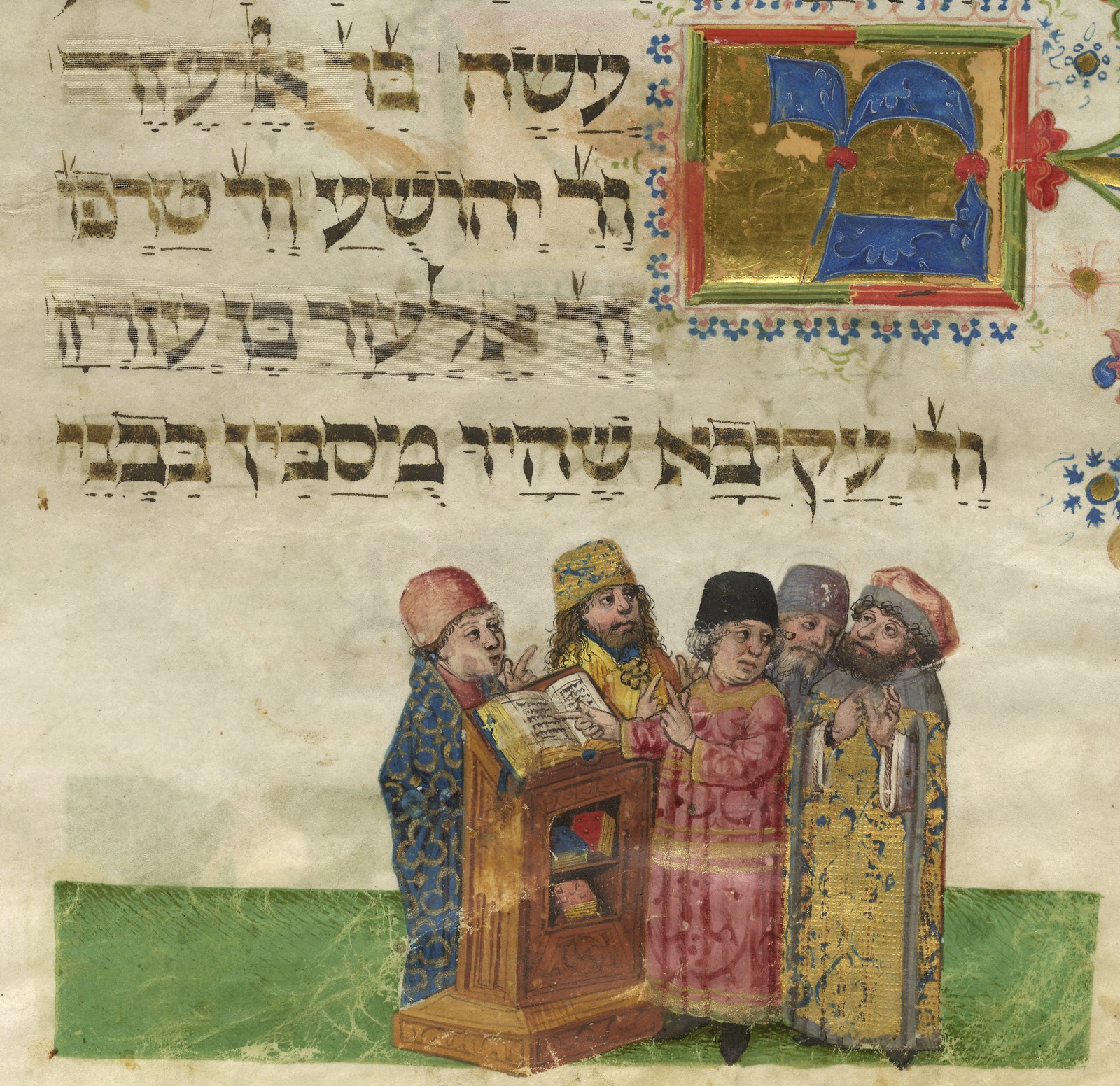
Illuminated detail from a fifteenth-century Ashkenazi Haggadah: above, three lines of black square Hebrew text and a great gold-leaf illuminated initial Mem framed in red, green and blue with red corner medallions and floral marginalia in pink, blue and green; below, five bearded rabbis in jewelled hats and richly patterned blue, gold-brocade and pink robes gather around a wooden book-stand on which an open book is set, gesturing in disputation, against a green ground line.
The Five Sages at Bnei Brak. R. Eliezer, R. Yehoshua, R. Elazar ben Azariah, R. Akiva, and R. Tarfon, who “reclined at Bnei Brak and discussed the Exodus from Egypt all that night.” Illuminated Ashkenazi Haggadah, late fifteenth century.
Teaching

Teaching

Dr. Vető teaches at Vassar in the Program in Jewish Studies, the Department of Religion, and the Program in Medieval & Renaissance Studies. Her content courses range across rabbinics, the Hebrew Bible, the New Testament, the history of anti-Judaism and anti-Semitism, and the Land and State of Israel — including the halakhot of war and peace, women’s rights, and the tensions between synagogue and state. She coordinates the Hebrew Language program at every level, from beginning Modern Hebrew through Talmudic Aramaic and Yiddish, and leads Vassar students on the Jewish Studies Travel Seminar through Jewish Europe.

Selected Courses

The Land of Israel Before the State of Israel
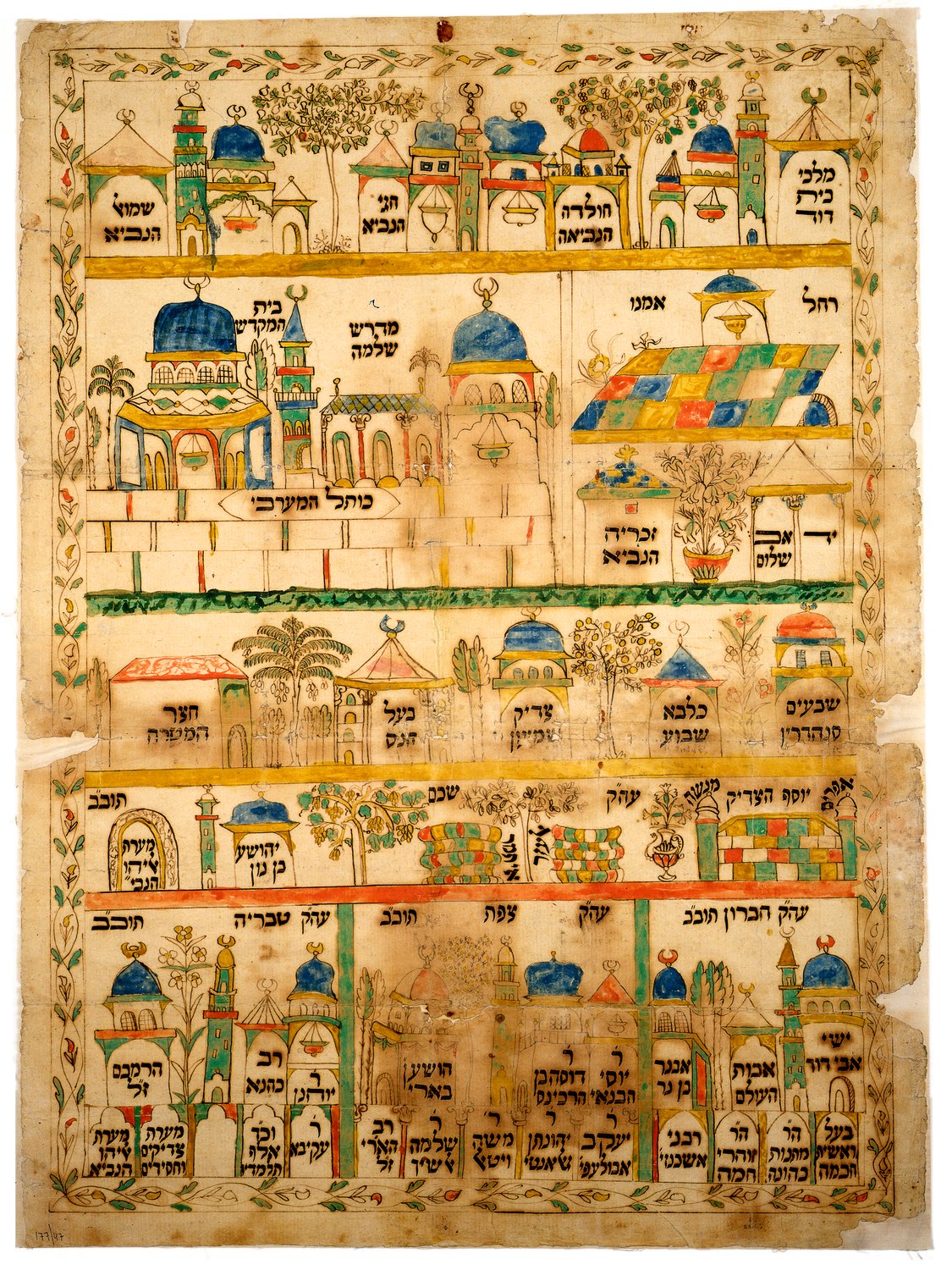
Folk-art panel of the holy sites of the Land of Israel: a vertical composition arranged in registers, each labelled in Hebrew — at the top, Jerusalem with the rebuilt Temple in domes; below, Hebron with the Cave of Machpelah; the towns of Safed, Tiberias and Meron with the tombs of patriarchs and rabbis; populated with cypresses, palms and pomegranate trees, with the four-cornered border filled by stylized vines and pairs of birds.
The holy towns and their shrines. Probably Land of Israel, second half of the nineteenth century.Jerusalem, the Israel Museum.

The Holy Land in Jewish (and, to some extent, Christian and Muslim) reality and imagination outside of — and prior to — political Zionism. Attachments to the land in religious texts, poetry, art, liturgy, and music; the tensions between those attachments and diasporic thought; the collusions and collisions among communities claiming the land from antiquity through the Ottoman period. Texts include Levenson’s Sinai and Zion, Mirsky on Rav Kook, Ravitzky’s Messianism, Zionism and Jewish Religious Radicalism, and Spiegel’s The Last Trial.
The Halakhot of War and Peace

The rabbinic and medieval sources on war, conquest, and the ethics of Jewish sovereignty — the laws of the optional (milḥemet reshut) and obligatory (milḥemet mitzvah) war, the treatment of combatants and non-combatants, the halakhic status of sovereignty itself — read alongside modern debates over the ethics of the State of Israel. A course in how a legal tradition thinks through, and sometimes fails to think through, the problem of power.

Unlocking the Bible

The Hebrew Bible as a literary and historical object. Students learn to take notes on academic readings, identify thesis and argument, articulate and evaluate scholarly claims, analyze ancient texts, and place ancient Israelite culture in historical context. The course doubles as a seminar in how to read a scholarly article and how to write one.

From Anti-Judaism to Anti-Semitism

The historical trajectory from religious to racial Jew-hatred — traced through religious, historical, political, and sociological sources, as well as art, literature, and music. Core texts include David Nirenberg’s Anti-Judaism: The Western Tradition, Bethencourt’s Racisms, Chazan’s From Anti-Judaism to Anti-Semitism, and Wistrich on Holocaust denial. A classroom designed for rigorous, respectful discussion of a volatile topic.

Jewish Law in Action

A biannual course that brings the methods and materials of the Halakhah in Action fellowship at Yeshivat Maharat into the undergraduate classroom. How does Jewish law work? What kinds of claims can it make? How does it change? The course uses agunah cases, Jewish–non-Jewish relations, and questions of economic justice as lenses for understanding the halakhic system as a living legal tradition.

Revolution, Heresy & Messianism

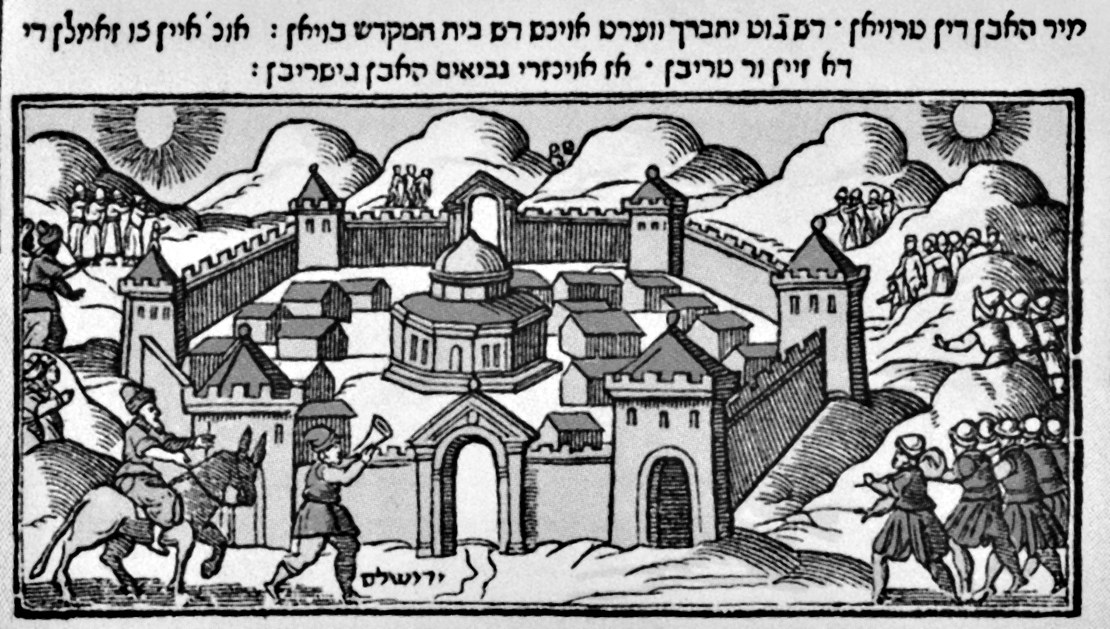
Black-and-white early-modern woodcut: a walled city of Jerusalem at center, dotted with domed towers and gabled houses, with the word ירושלם (Jerusalem) inscribed at the foot; figures stream toward the gates from both sides, and at the lower left a man rides into the city on a donkey blowing a horn; the sun and moon shine together above the walls, and Yiddish text fills the upper margin.
Messianic Jerusalem as the ideal Renaissance town. Seder Haggadah Shel Pessaḥ, Venice: Giovanni di Gara, 1609, fol. 24r.

Messianic expectation and messianic failure in Jewish history — from the Second Temple period through Sabbateanism, Frankism, and the modern messianisms of Chabad and religious Zionism. The course reads the theological stakes of these movements alongside their social and political consequences, and asks what it would mean for a messiah to have, or to lack, a body.

Interrogating Religious Extremism

A comparative consideration of religious extremism — Jewish, Christian, Muslim — across the twentieth and twenty-first centuries. The course examines the conditions that produce extremist readings of religious traditions, the textual and rhetorical structures that sustain them, and the difficult question of how religious communities respond when their own sources are marshalled in the service of violence.

Hebrew Language Program

Coordinator since 2021. Since her arrival, enrollment in Hebrew has increased markedly, and in 2024 a Jewish Studies major was admitted to the Talmud track of Emory’s PhD program in Comparative Literature — the first in the program’s recent memory.

Title page of an early eighteenth-century printed Hebrew grammar in English: square Hebrew letters at the top reading דקדוק לשון עברית transliterated below as DICKDOOK LESHON GNEBREET, then ‘A GRAMMAR OF THE Hebrew Tongue, BEING An ESSAY To bring the Hebrew Grammar into English…’ followed by a small Hebrew citation, the imprint ‘By JUDAH MONIS, M. A.’ and ‘BOSTON, N.E. Printed by JONAS GREEN, and are to be Sold by the AUTHOR at his House, in Cambridge. MDCCXXXV.’
Judah Monis, Dickdook Leshon Gnebreet. A Grammar of the Hebrew Tongue (Cambridge, MA, 1735) — the first Hebrew grammar printed in the American Colonies.
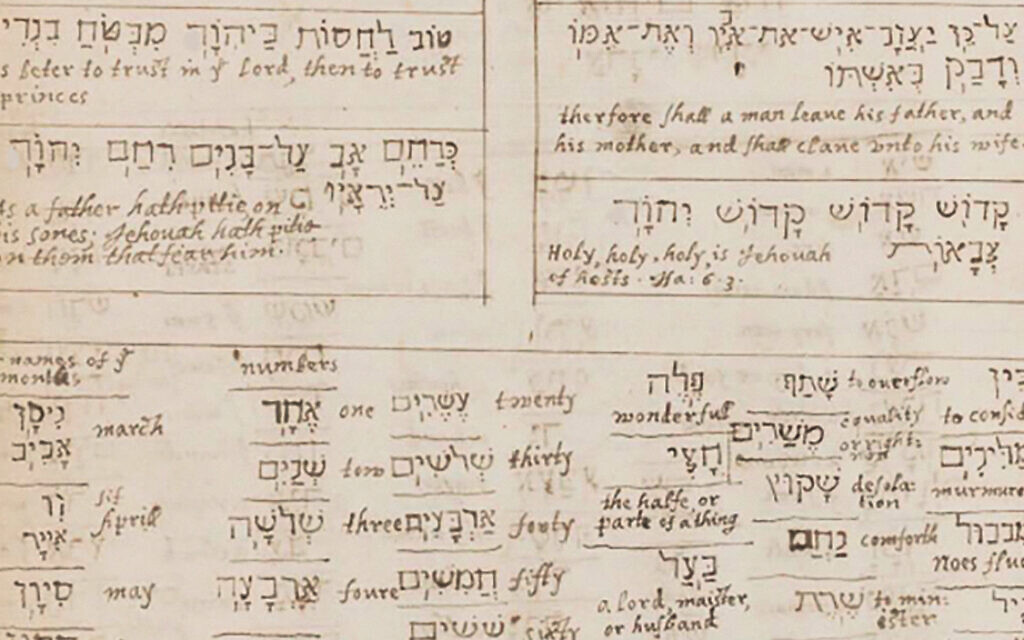
Yellowed manuscript flyleaf in two columns, ruled in pale ink: Hebrew words in a careful seventeenth-century hand paired with English equivalents — biblical verses, names of months (Nisan/March, Iyar/April, Sivan/May), numbers and basic vocabulary.
A Hebrew exercise written by Plymouth Colony Governor William Bradford in the flyleaf of his manuscript Of Plimoth Plantation, completed 1650.
HEBR 105 / 106

Elementary Hebrew

The year-long beginning Hebrew sequence: alphabet, grammar, vocabulary, conversation, short readings. Students emerge at an Intermediate Low/Mid level across all four skills — reading, writing, listening, speaking — with the foundation to continue into intermediate, advanced, or classical Hebrew.
HEBR 205 / 206

Intermediate Modern Hebrew

Continuing work on grammar, syntax, composition, and conversation, with readings from Israeli literature, essays, and journalism.
HEBR 305

Advanced Modern Hebrew

Reading and writing at an advanced level, with an emphasis on literary and scholarly texts.
Independent Study

Talmudic Hebrew & Aramaic

For students with a grounding in Biblical or Modern Hebrew who wish to work directly with Talmudic texts. The course is rigorous in its linguistics and sensitive in its pace, offered one-on-one or in very small groups.
Reading Group

Yiddish

A facilitated reading group for students interested in Yiddish language, literature, and culture. Periodic, on demand.

Travel Seminar

Jewish Studies

Jewish Studies Travel Seminar

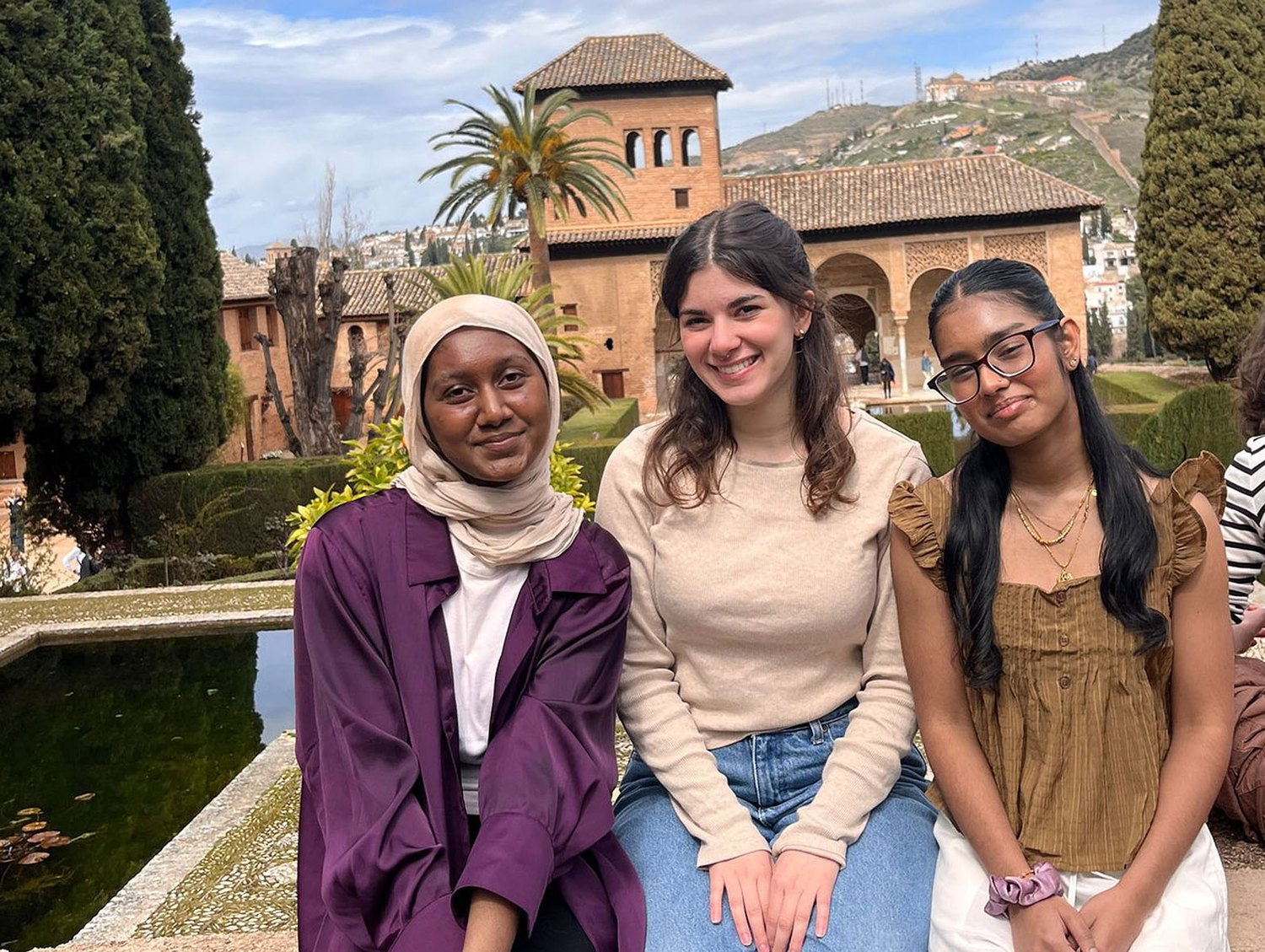
Three Vassar students sit shoulder-to-shoulder on a low marble parapet in front of a long reflecting pool, with the brick-and-tile Alhambra Partal pavilion and arches behind them, a tall palm rising on the left and the Sierra Nevada in the distance: a young woman in a cream hijab and aubergine open coat, a young woman in a beige long-sleeved sweater and jeans with shoulder-length brown hair, and a young woman in a mustard-yellow ruffled top with long dark hair and glasses, all smiling at the camera.
Anisha Azizi VC ’27, Alexandra Polur Gold VC ’25, and Maisha Rahman VC ’27 enjoy a day at the Alhambra in Granada during the Jewish Studies Travel Seminar in Spain. Photo courtesy of Alexandra Polur Gold VC ’25.
A flagship experiential course in the Program in Jewish Studies that has brought a racially, ethnically, and religiously diverse cohort of Vassar students to Jewish Vienna, Berlin, Prague, Paris, Budapest, Florence, and Venice — including a 2016 visit on the occasion of the Quincentennial of the Venetian Jewish community.